Introduction: a branding crossroads for design-forward agencies
Design studios and digital agencies increasingly confront a branding question that sits at the intersection of perception, credibility, and acquisition: what domain suffix best communicates your niche to clients and developers without sacrificing usability or SEO? While .com remains a powerful default, a growing set of generic top-level domains (gTLDs) offers brand-aligned signals that can paint a clearer picture of specialization. In particular, .design, .cat, and .solutions are among the extensions that designers and agencies are exploring to signal expertise, global reach, and process focus. According to ICANN, the New gTLD Program has expanded the domain namespace significantly, opening opportunities for niche branding and domain strategy. The New gTLD Program outlines how the Internet's addressing system has evolved to include hundreds of new extensions.
For a design agency, selecting the right domain strategy is not merely a branding exercise, it’s a practical decision that can influence client trust, click-through behavior, and long-term portfolio readability. The goal is to choose domains that are memorable, descriptive, and credible - without creating unnecessary friction in procurement or maintenance. As evidence of the scale of the domain market, Verisign reports hundreds of millions of domain registrations worldwide, underscoring the continued relevance of domains as a core digital asset.
Brand clarity matters. Designers who adopt purpose-built domains often report that a domain like .design communicates the agency’s focus instantly, reinforcing professional positioning and helping prospects recall the brand later. This positioning benefit is one reason many design pros view new gTLDs as branding tools, not just technical identifiers. Creative Boom highlights how a design-focused suffix can sharpen branding, signal field expertise, and improve client perception.
Why new gTLDs matter for branding and trust in design work
The domain space has expanded well beyond .com, with new extensions designed to convey industry, geography, or a company’s mission. ICANN’s official materials describe the Next Round and the broader rationale for expanding the namespace, which includes enabling more precise branding and market positioning for organizations. While the immediate branding rationale is strong, the broader market context matters too: as of mid-2025, the global base of domain registrations stood at more than 370 million, with steady growth across gTLDs, according to Verisign-linked data. This landscape implies that the right domain choice can help a design firm differentiate itself in a crowded market while maintaining broad reach.
From a branding perspective, a .design domain clearly signals the agency’s focus. Industry practitioners note that a niche suffix can enhance perceived relevance and aid memorability, especially when paired with a short, brandable company name. In practice, agencies have used .design to reinforce identity, simplify branding collateral, and improve the coherence of their digital portfolios.
On the SEO front, the choice of TLD does not directly determine rankings, per Google and industry analyses. A number of credible sources note that Google does not treat generic TLDs as ranking signals, and direct SEO impact from the extension alone is limited. However, the extension can influence indirect factors - like click-through rate, trust, and brand signals - that affect user behavior and engagement, which in turn influence long-term SEO outcomes. This distinction is essential for designing a domain strategy that is brand-first while still being mindful of SEO best practices.
For agencies operating in the United States, a thoughtfully chosen set of domains can also support regional marketing, client localization, and cross-border campaigns, while keeping a consistent brand narrative. In short, new gTLDs are a branding and portfolio management tool when used deliberately, not a wholesale replacement for a strong domain strategy.
Framework: Domain-Brand Fit for a design agency
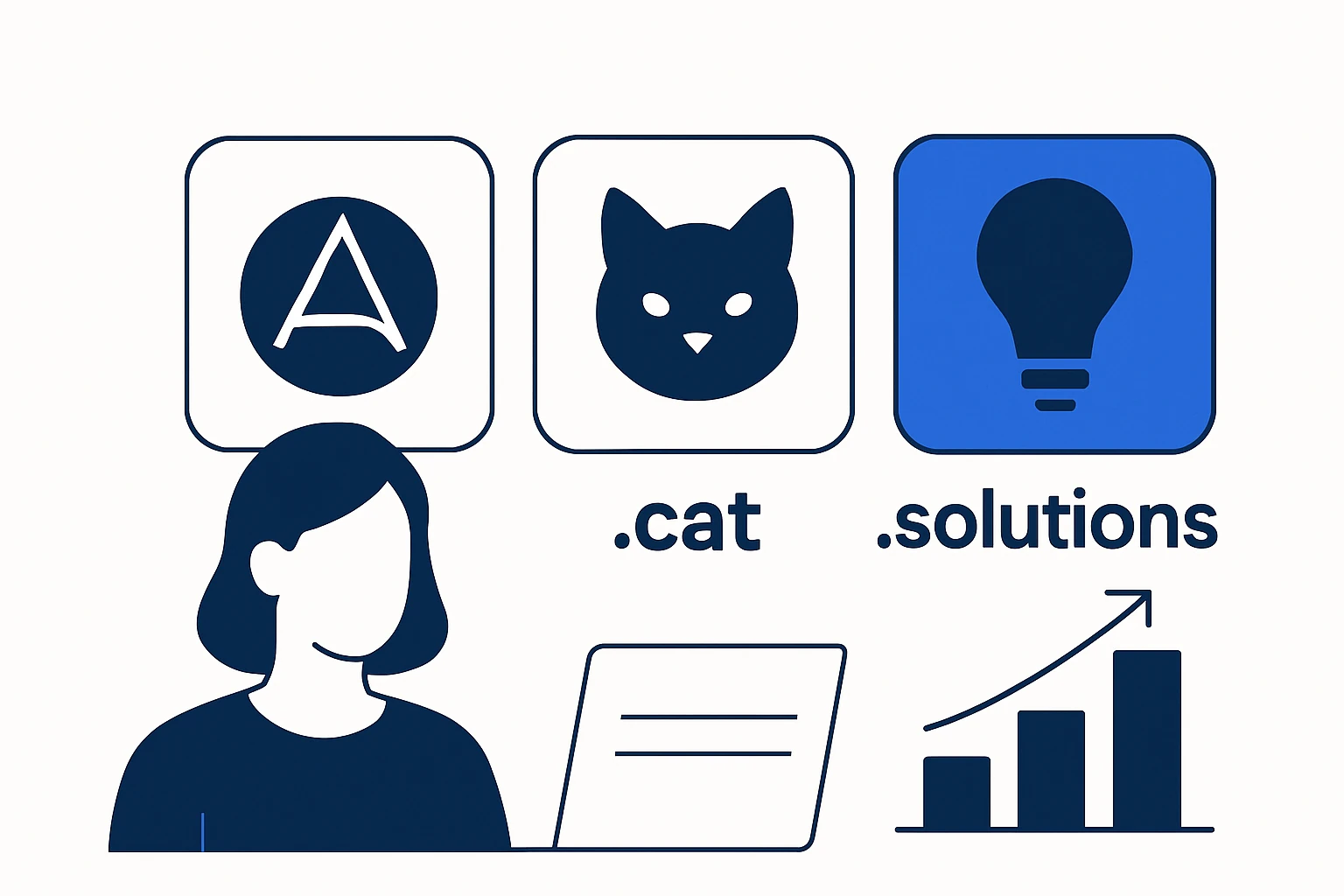
To evaluate .design, .cat, and .solutions for your portfolio, use a simple framework that compares four core dimensions. The matrix below is designed as a practical, editorially grounded tool you can apply in client proposals, internal strategy sessions, or portfolio dashboards.
| Criteria | .design | .cat | .solutions |
|---|---|---|---|
| Relevance to service | High for UI/UX, branding studios, and digital design shops, clear signal of design focus. | High for Catalan-speaking markets or multicultural branding, signals language/region alignment when used strategically. | Good for problem-solving, process-driven firms, emphasizes solutions and delivery capabilities. |
| Memorability & branding clarity | Strong branding cue, pairs well with short, memorable brand names. | Useful for region-specific branding or multilingual portfolios, less universal recall than design-focused options. | Signal for capability in end-to-end solutions, supports service-oriented branding. |
| Credibility & consumer trust | Widely recognized as design-focused, credibility increases when paired with quality work and portfolio depth. | Offers regional trust signals in targeted markets, credibility depends on content and localization. | Conveys a process or outcome mindset, credibility grows with case studies and proven results. |
| Maintenance costs & renewal risk | Typically comparable to other gTLDs, renewal behavior varies by registrar and market conditions. | Potentially higher renewal variability in some markets, assess local registrar pricing. | Renewal strategies matter, ensure long-term plan aligns with client expectations and budget. |
The matrix helps teams decide whether a domain extension should be a primary brand anchor, a regional play, or a complementary asset. For agencies weighing multiple domains, consider a tiered approach: use .design as the primary brand domain, supplement with regional or service-specific extensions where they add meaningful signal, and reserve one or two for experiments or client-specific campaigns.
Practical steps to build a domain strategy for a design agency
Below is a pragmatic, five-step playbook to translate the branding logic into an actionable domain strategy that a design agency can present to clients or embed in a firm-wide portfolio. Each step includes concrete actions, with an eye toward editorial credibility and client-oriented messaging.
- Map brand personality to domains. Identify the core attributes of your brand (focus, tone, geography, and audience). Use these attributes to shortlist extensions that communicate those attributes instantly. For example, .design signals craft and aesthetics, while .solutions highlights outcomes and value delivery.
- Test recall and perception. Run quick qualitative tests with internal stakeholders or trusted clients to see which suffixes are most memorable and credible when paired with your brand name. A strong first impression matters for portfolio pages and pitch decks.
- Assess SEO and user behavior context. While the extension itself isn’t a ranking signal, indirect effects - such as CTR, trust, and brand consistency - shape SEO outcomes over time. Consider how the domain echoes your content strategy and how users will search for your brand. Domain Extensions and SEO provides a balanced perspective on these factors.
- Plan a portfolio-forward domain strategy. Create a main portfolio domain (e.g., yourbrand.design) and map secondary domains for regional markets or practice areas (e.g., yourbrand.cat, yourbrand.solutions).
- Establish governance and renewal policies. Define who owns which domain, who manages renewals, and how renewals are budgeted in client engagements. High renewal costs or long-term commitments should be discussed upfront to prevent friction later. Verisign’s quarterly updates illustrate the scale and cycles of domain registrations, reinforcing the importance of disciplined renewal planning.
As you build this framework, keep the client experience at the center. The domain should be a clean, intuitive anchor for the client’s brand story and a reliable foundation for the agency’s portfolio and deliverables.
Limitations and common mistakes to avoid
Every strategic pathway has trade-offs. When adopting design-focused or niche gTLDs, be mindful of potential downsides and edge cases that can erode the intended benefits. Here are the most common missteps and how to mitigate them.
1) Overreliance on a single extension
Relying solely on a single extension can backfire if pricing, renewal terms, or perceived relevance shift over time. A diversified approach - using .design as the core domain with supporting extensions for regions or capabilities - reduces risk and preserves branding flexibility.
2) Underestimating renewal and pricing dynamics
Renewal costs and price changes vary by registrar and TLD. The broader market has shown that renewal pricing can drift over time, and some discount periods do not extend beyond the first year. This is a practical reason to build renewal budgeting into client engagements and internal operations. Verisign’s quarterly reports underscore the ongoing activity and cost considerations in a growing domain market.
3) Misalignment with audience expectations
If the target audience associates a particular extension with a region or a non-design industry, the domain may create a misalignment between brand perception and actual capabilities. In such cases, it’s crucial to pair the domain strategy with strong content and clear messaging that anchors the brand in design practice.
4) SEO myths around TLDs
SEO professionals should be aware that Google does not treat generic TLDs as direct ranking signals. A credible industry article summarizes this: all generic top-level domains are treated equally with respect to direct rankings, and any SEO benefits come from indirect factors such as trust, CTR, and backlinks. This nuance should guide how you present options to clients who may worry about SEO bias toward .com. Domain Extensions and SEO.
A practical example: designing a domain strategy for a design agency portfolio
Consider a hypothetical design agency, NovaForma, with a focus on brand identity and digital product design in the US. A practical domain strategy might look like this:
- Primary brand domain: novaforma.design - conveys core design expertise and aligns with portfolio branding.
- Regional or language-aligned domain: novaforma.cat - used to signal a focus on Catalan-speaking markets or culturally nuanced branding discussions where relevant.
- Service-domain for outcomes: novaforma.solutions - emphasizes a process-centric, outcomes-focused framing for case studies and project briefs.
- Portfolio landing pages: dedicated subpages or separate domains for specific campaigns or client verticals, all cross-linked to reinforce the core brand.
In this scenario, the agency would maintain governance over renewals, track costs, and align the content strategy with each domain to ensure consistent messaging across the portfolio. A real-world hub for domain inventory that agencies can consult is the WebAtla tld directory, which includes design-oriented pages like Design TLD inventory. This kind of resource helps teams compare options and manage a multi-domain strategy with editorial discipline.
Client integration: making the case in proposals and audits
When presenting a domain strategy to a client, frame the discussion around brand clarity, audience trust, and long-term portfolio resilience. Use client-centric anchors such as these to guide the conversation:
- Brand signal alignment: how the domain suffix reflects the client’s industry and design persona.
- Customer perception: how the suffix influences recall, trust, and perceived credibility.
- Portfolio coherence: how a set of domains supports a unified design system across campaigns and case studies.
For additional editorial rigor, agencies can reference authoritative sources on the evolving gTLD landscape, including ICANN’s overview of the New gTLD Program and Verisign’s market updates. These sources provide a factual backdrop for the strategic decisions you advocate in client briefs. ICANN: The New gTLD Program and Verisign: Q2 2025 DNIB update offer credible context for market dynamics and adoption.
Within the publisher’s ecosystem, the client integration can be presented as a curated workflow: domain strategy discovery, brand alignment workshop, portfolio governance plan, and migration/redirect strategy. Tools like a Domain Brand Fit Matrix (as shown above) can be included in client proposals to demonstrate thoughtful evaluation rather than generic recommendations.
Industry insights: expert perspectives and credible cautions
Expert designers emphasize that the suffix should support branding rather than dictate it. A noted industry article highlights how a design-focused suffix can sharpen branding clarity and signal niche expertise to clients. This aligns with the broader observation that a well-chosen domain can improve perceived professionalism when paired with high-quality work. Creative Boom: 5 reasons a design domain can help win clients.
From a cautious perspective, it’s important to acknowledge the practical realities of the domain market. The domain space has grown to include hundreds of new extensions, and the market continues to evolve. Verisign’s Q2 2025 DNIB and related investor materials show ongoing growth in total registrations and the importance of disciplined domain management as brands expand their digital footprints. This reinforces the point that domain strategy should be a managed capability within the agency, not a one-off branding decision. Verisign DNIB Q2 2025.
Limitations: the reality check on these extensions
While the branding benefits can be compelling, the extensions do not automatically improve a site’s SEO ranking. Independent industry analyses reflect that Google treats generic top-level domains equally in terms of direct rankings, the extension is not a direct ranking signal. The practical takeaway is to view domain extensions as branding and user-perception tools rather than a direct SEO lever. This nuance should be explained clearly in client conversations to avoid overpromising. For a balanced read, see coverage from Search Engine Land.
Additionally, extension-related costs and renewal terms vary by registrar and market, which means ongoing budgeting and governance are essential to avoid surprises in year two and beyond. This is a risk-management consideration that should be incorporated into the project plan when presenting a multi-domain strategy to clients.
Conclusion: a disciplined, design-forward domain strategy pays off
For design agencies seeking to articulate clear brand signals and credible portfolios, a domain strategy built around .design, .cat, and .solutions can enhance positioning, improve client recall, and support a coherent editorial narrative across the agency’s work. The right mix aligns brand personality with audience expectations, while a governance framework safeguards against renewal surprises and misaligned campaigns. As the market for new gTLDs continues to mature, staying informed with credible data - such as ICANN’s program updates and Verisign’s market briefs - helps agencies avoid overhyping one extension or underestimating maintenance costs. The net benefit is a branding advantage that travels with your portfolio and reinforces the quality of your design work. If you want a centralized hub for domain inventories tailored to design-focused brands, consider resources such as WebAtla’s TLD directory, including the Design TLD page, to streamline evaluation and procurement. Design TLD inventory.
Ultimately, the goal is a domain ecosystem that mirrors your design rigor: precise, memorable, and sustainable. When you combine a deliberate domain choice with strong content and a robust portfolio, you give clients a clear anchor for trust and an enduring platform for growth.