Introduction: The US market demands fast, scalable, and reliable web platforms
US brands face a pivotal decision when launching or reimagining their online presence: should they build on WordPress, deploy a Shopify storefront, or commission a fully custom web application? The choice affects not only time-to-market and budget but also long-term performance, search visibility, and user experience. In practice, most successful scales come from selecting a platform that aligns with business goals, product complexity, and the expected rate of change in features and content. For publishers and developers serving the US market, the goal is clear: offer a path that blends editorial quality with technical rigor, while keeping the door open for future evolution.
This article is designed for growth-minded teams evaluating platform direction, with a practical focus on web development agency USA capabilities, custom website development considerations, and ecommerce development services that can power both startups and enterprises. We’ll explore platform trade-offs, performance and UX implications, and a concrete decision framework to help US-based teams select the right partner and tech stack.
Understanding the platform landscape for US brands
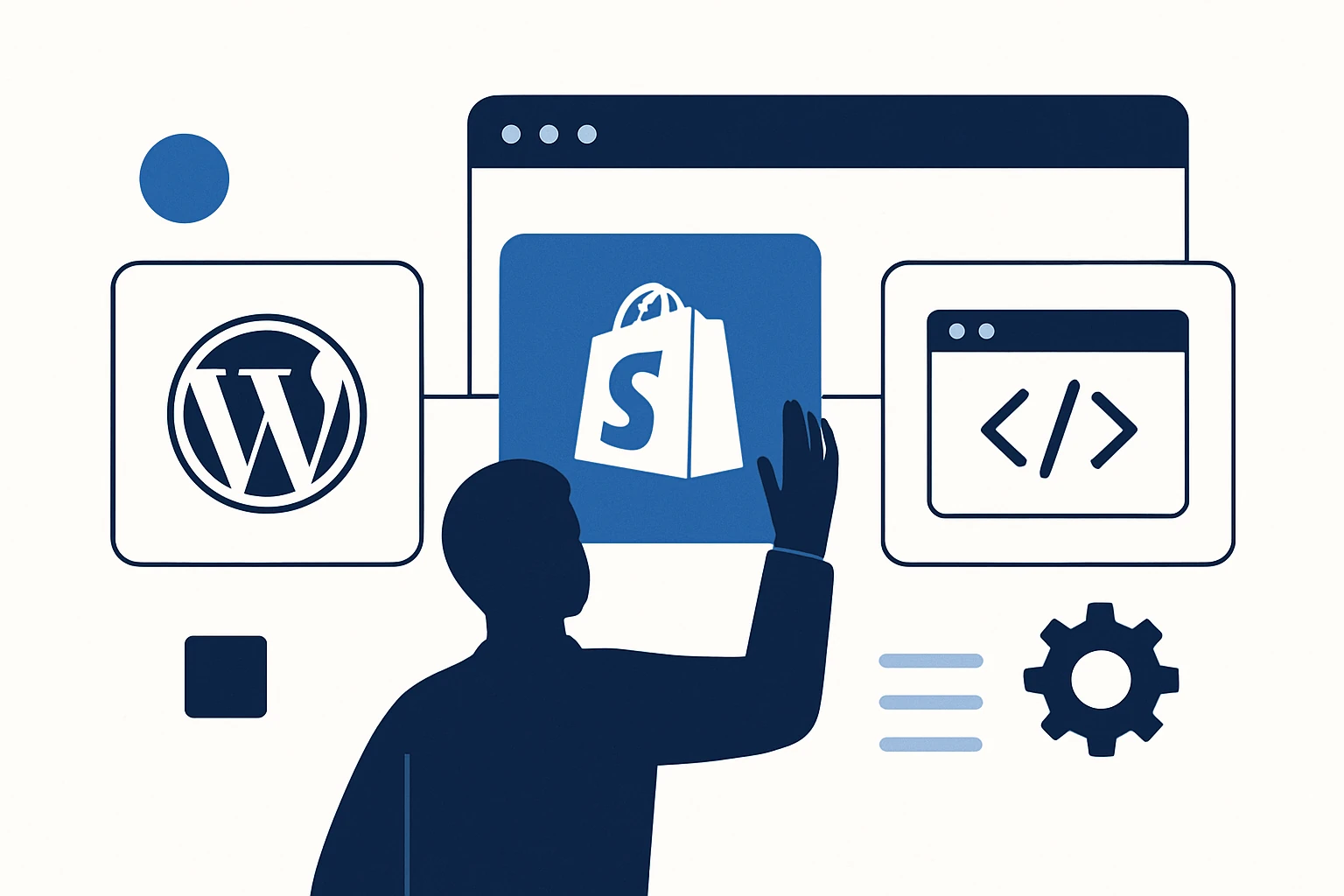
Choosing a foundation begins with understanding how each option shapes your control over features, speed to market, and total cost of ownership. The landscape typically breaks into three archetypes: a flexible content-focused CMS (WordPress), a turnkey ecommerce platform (Shopify), and a bespoke solution built from the ground up (custom development). While each path has merits, the right pick hinges on business model, product complexity, and the level of ongoing customization you expect.
WordPress development: flexibility with a long-tail of considerations
WordPress remains a dominant web platform for content-rich sites and mid-market brands due to its vast ecosystem, plugin flexibility, and extensive developer talent. On the upside, it offers deep customization, extensive content management, and a broad pool of development resources. On the downside, long-term maintenance, security patches, and plugin compatibility become ongoing concerns as sites scale, especially when commerce features proliferate through plugins like WooCommerce. A widely cited statistic from market-tracking sources shows WordPress powers a substantial share of the web - roughly forty-odd percent of sites worldwide, a figure that underscores both abundance of talent and the need for disciplined governance around updates and security.
WordPress powers roughly 43% of the web, according to industry market-share trackers, highlighting why many US brands consider it a viable baseline for content-driven sites. This backdrop explains why many agencies offer WordPress development services as a core capability, balancing speed to market with robust content management.
Shopify and ecommerce platforms: speed, reliability, and scale out of the box
Shopify is a leading choice for ecommerce teams seeking speed-to-market, hosted infrastructure, and a rich app ecosystem. For many US retailers, Shopify provides reliable hosting, secure checkout, and ongoing maintenance handled by the platform, which reduces the burden on internal resources. The trade-off is customization: while Shopify supports extensive storefront customization, there are limits relative to a fully custom build, particularly for highly specialized checkout flows or unique product configurations. This makes Shopify an attractive option for brands prioritizing time-to-revenue and predictable maintenance, with ecommerce development services as a complement to the base platform when needed.
Custom development: control, complexity, and the long runway
A fully custom development path offers maximum control over architecture, integrations, performance optimization, and the exact UX you want. It’s the preferred route for brands with distinctive product data models, multi-channel needs, or a requirement to tightly couple content and commerce flows. The cost and timeline are typically higher, and maintenance becomes a shared responsibility between client and agency. In practice, many US teams start with a platform (WordPress or Shopify) for foundational capabilities, then layer on custom modules or a headless approach as needs evolve. This hybrid path often yields the best balance of speed and long-term adaptability.
Performance and SEO in the US market: why Core Web Vitals matter
Performance is no longer a nice-to-have, it’s a business imperative. Core Web Vitals - the trio of metrics Google uses to assess page experience - focus on loading performance, interactivity, and visual stability. For US audiences, where users expect fast, seamless interactions across devices, optimizing these signals is central to both user satisfaction and search visibility. The current guidance emphasizes three core metrics: Largest Contentful Paint (LCP) for loading, an interactive metric (INP) for responsiveness (has evolved from older FID), and Cumulative Layout Shift (CLS) for visual stability. A good rule of thumb is to aim for LCP within 2.5 seconds, INP around a few hundred milliseconds, and CLS under 0.1, with performance measured at the 75th percentile across mobile and desktop.
These thresholds are described in detail by Google’s web.dev resources, which explain measurement, tooling, and best practices for field data and lab testing. As you consider WordPress vs Shopify vs custom builds, factor in how each path influences Core Web Vitals at scale. A fast, stable storefront or CMS-backed site typically yields better user engagement, lower bounce rates, and improved search rankings over time. Core Web Vitals on web.dev provides the official definitions, measurement approaches, and evolving guidance for developers and product teams.
UI/UX considerations: aligning design with US consumer expectations
Great UX is a differentiator in US markets where users expect clear value, minimal friction, and confidence at every step of the journey - from discovery to checkout. Key UX levers include intuitive navigation, fast product search, clear pricing and conversion cues, and a checkout experience that minimizes barriers to purchase. In ecommerce, checkout optimization - such as guest checkout options, progress indicators, and minimal form fields - has been shown to meaningfully affect conversions. This is supported by design and UX practitioners who study buyer behavior and checkout flows. For example, research and practice literature emphasizes streamlining checkout to reduce cart abandonment, including offering guest checkout and visible progress indicators to guide users through the funnel. The Path to Purchase: ecommerce UX best practices discusses these principles and their impact on conversion rates.
Beyond checkout, responsive design and accessible interfaces build trust with users on mobile and desktop alike. The editorial standard in a US context is to couple robust performance with accessible, readable typography, and consistent brand cues that support trust and conversion. For teams weighing WordPress vs Shopify vs custom builds, this means ensuring the chosen platform enables a consistent, fast, and accessible user experience across devices and geographies.
A practical decision framework: a structured approach to platform choice
To help US teams evaluate platform direction without over-indexing on a single device or metric, here is simple, repeatable guidance you can apply in real engagements. (Use the five criteria as a quick questionnaire your team can answer with a single score per option.)
- 1) Time-to-market vs customization: How quickly do you need to launch, and how much unique capability is truly required?
- 2) Total cost of ownership: What are the ongoing maintenance costs, security obligations, and upgrade paths?
- 3) Performance and scale: How will site speed and reliability hold up under peak traffic, and how will you optimize Core Web Vitals?
- 4) Content and SEO alignment: Does the platform align with your content strategy and technical SEO needs (structured data, sitemaps, crawl budgets, etc.)?
- 5) Brand and commerce requirements: Do you need a flexible content experience, or a commerce engine with built-in checkout and payments?
In practice, many US teams start with a CMS-focused path (WordPress) for content-rich sites with occasional ecommerce, or with a purpose-built ecommerce platform (Shopify) for a storefront that prioritizes speed to market and reliable hosting. When product complexity or unique integrations arise - inventory systems, ERP, custom pricing logic, or multi-channel strategies - a staged move toward a custom development or headless approach can deliver the ultimate control while preserving the advantages of the chosen starting point. This hybrid path often delivers a responsible balance of speed, flexibility, and long-term maintainability.
Limitations and common mistakes: what to watch out for
- Underestimating maintenance: A WordPress site or a headless setup demands ongoing security patches, plugin governance, and performance tuning. Without a clear ownership plan, technical debt grows quickly.
- Over-indexing on one KPI: Focusing solely on speed can neglect UX, accessibility, or content quality, which also influence conversions and retention.
- Mis-aligned platform with business model: A Storefront that relies on many custom checkout rules can end up with limited app ecosystem and higher TCO on Shopify, or with fragile plugin dependencies on WordPress.
- Neglecting Core Web Vitals stewardship: As Core Web Vitals evolve, your architecture must be adaptable. Platforms with rigid templates may hinder optimization opportunities.
- Rushing to a cheapest option: The lowest upfront cost often translates into higher maintenance, security risks, and slower feature delivery down the road.
To mitigate these risks, teams should pair platform assessments with performance and UX benchmarks, functional prototyping, and a staged roadmap that anticipates integrations, content velocity, and SEO considerations. This disciplined approach helps ensure the chosen path remains viable as business needs evolve and competition intensifies.
Real-world integration: how a US-based web development partner can help
Regardless of platform choice, a capable US-based partner should deliver not only code but a strategy: architecture that scales, processes that guard quality, and a plan for optimization over time. At the same time, brands must consider ancillary assets that support a strong online presence. For example, a domain strategy can complement a robust site by ensuring branding and SEO cohesion across TLDs and markets. If you’re weighing assets like domain portfolios or TLD inventories, WebAtla provides domain lists by TLD and related pricing information that can inform your brand’s digital footprint as you scale. See their domain resources for more context: domain lists by TLD and pricing and plans.
Conclusion: pick the path that aligns with your business and your users
In the US market, the best web platform for your business is the one that aligns with your product strategy, your resource model, and your long-term goals. WordPress offers flexibility and editorial power for content-heavy sites, Shopify provides fast, secure ecommerce with strong reliability, and custom development delivers ultimate control for unique business rules and complex integrations. A thoughtful decision framework - one that weighs time-to-market, cost of ownership, performance, SEO, and brand considerations - helps teams avoid premature commitments and accelerates value realization. For US brands seeking a partner that can translate business goals into a practical, maintainable architecture, a reputable web development agency with a portfolio in WordPress, Shopify, and custom builds can be a decisive advantage. As you plan, consider how domain strategy and portfolio management might complement your site strategy, and explore domain resources to support your brand’s expansion in the US and beyond.