Introduction: why a domain portfolio matters for US startups
For fast-scaling tech companies and startups in the United States, your online identity is a system, not a single once-and-done asset. A thoughtful domain portfolio helps protect your brand, expands your reach into new markets, and reduces the risk that competing brands or squatters siphon traffic away from your core site. The domain surface you own or control can influence search visibility, mail deliverability, and the cadence of your marketing campaigns. While most teams focus on a primary brand domain, a disciplined approach to additional TLDs - including both country-code domains and information-oriented or brandable generic extensions - can deliver measurable returns when aligned with product strategy and governance. (nic.ma)
Understanding TLDs and their signals
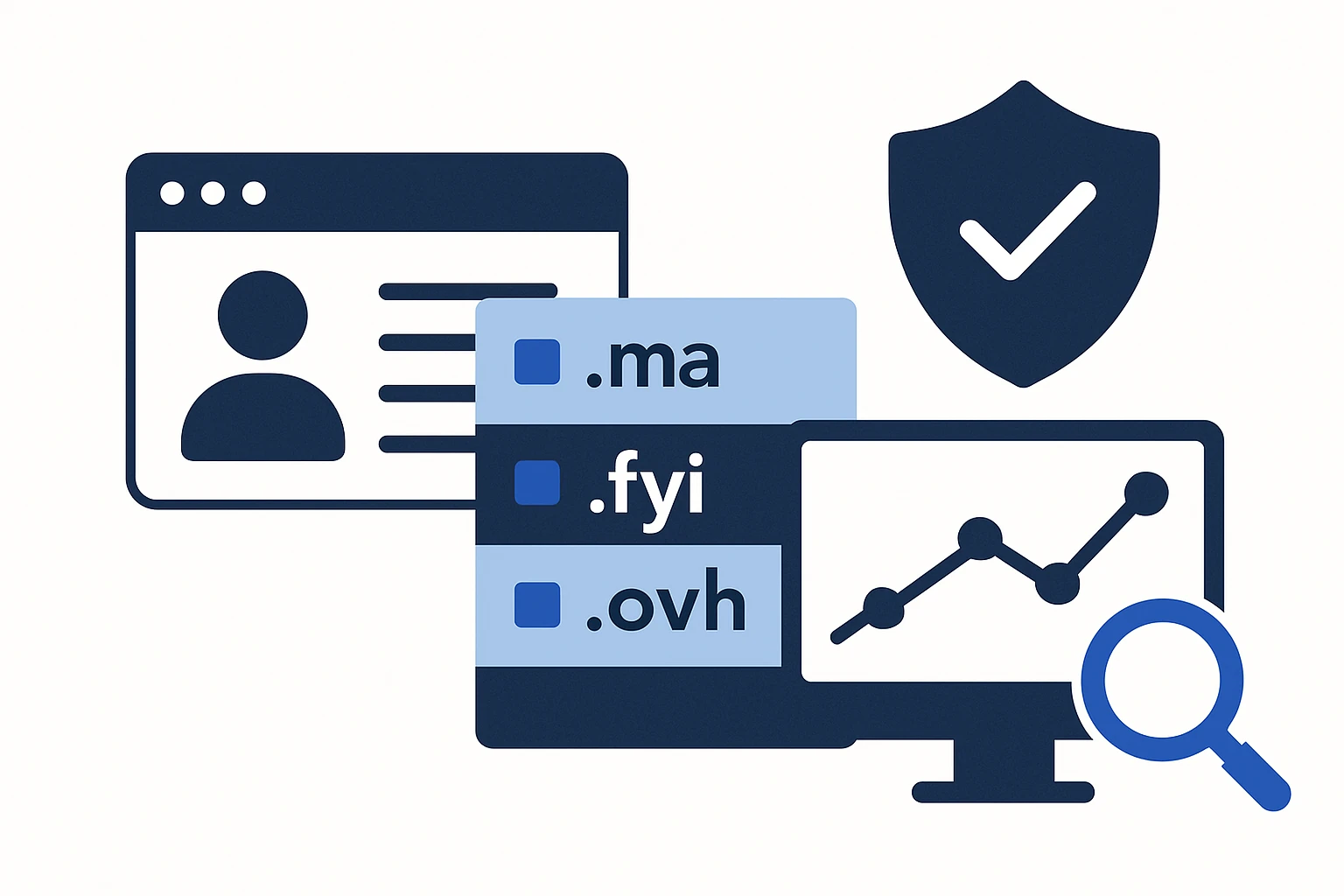
Top-level domains (TLDs) convey more than mere routing, they signal intent to users and search engines. A country-code TLD (ccTLD) like .ma indicates locality, which can be leveraged for regional campaigns, localized content, or brand protection in a specific market. The .ma domain is the official Moroccan ccTLD and is managed under the regulatory framework of ANRT (Agence Nationale de Réglementation des Télécommunications) in Morocco. This makes it a purposeful choice for brands seeking a regional presence or domain variation as part of a broader international strategy. (nic.ma)
For information-centric branding or product marketing, generic or open-ended extensions such as .fyi can convey a clear informational intent. In DNS practice, .fyi is treated as a standard gTLD option that registries and registrars support for DNS configuration and DNSSEC. This makes it a viable candidate for content-focused landing pages, knowledge bases, or product documentation where the goal is clarity and discoverability. (docs.aws.amazon.com)
Meanwhile, newer or brand-oriented gTLDs like .ovh are used by hosting and tech ecosystems to reinforce a company or community theme. The .ovh extension is available through registries and providers that market it as a distinct branding layer within a portfolio. This kind of TLD can complement a core brand, support product-specific campaigns, or host community-driven content. (nic.ovh)
Why consider .ma, .fyi, and .ovh in a US portfolio
Choosing the right TLDs requires balancing branding intent, SEO nuance, and risk. Here is a practical lens on the three extensions you asked about, and how they might fit a US-based technology company’s portfolio strategy.
.ma: regional strategy with disciplined scope
As a country-code TLD for Morocco, .ma can be a deliberate asset for brands pursuing a foothold in North Africa or a broader Francophone market. The registry and regulatory environment define how registrations are handled, which is important for governance and risk management in a growing portfolio. If your company operates in or plans content targeting Africa or the MENA region, securing a few regionally relevant domains can support landing pages, campaigns, or localized support hubs. (nic.ma)
.fyi: clarity of purpose for information-driven content
The .fyi extension is widely used for information-forward sites or pages that answer specific questions, guides, or feature overviews. It’s a natural fit for product docs, knowledge bases, and customer-support portals that you want to be easy to find and to differentiate from the primary brand domain. DNS-wise, .fyi behaves like other generic extensions, so it’s straightforward to configure and protect. (docs.aws.amazon.com)
.ovh: branding within tech ecosystems
.branding with .ovh can be valuable if your product or community aligns with the OVH ecosystem, a well-known hosting and cloud provider. A branded .ovh domain can host a technical community hub, developer resources, or focused product pages without competing directly with your main brand namespace. As with any new TLD, the decision should be guided by how well it supports your content strategy and how it’s perceived by your target audience. (nic.ovh)
How to source domain lists by TLD: practical steps
For teams that want reproducible, auditable access to domain lists by TLD (such as .ma, .fyi, and .ovh) without depending on ad hoc searches, a structured approach matters. A domain list is not merely a catalog, it’s a signal of naming patterns, potential acquisition targets, and risk to your brand. The client’s offering in this space often centers on aggregating and delivering curated lists by TLD, coupled with governance and analytics. If you’re evaluating options, consider these practical steps:
- Clarify your naming strategy: define what you want to protect, what audiences you’re targeting, and which product or campaign tribes will own the names.
- Source from reputable registries and registrars: prioritize data that comes from official or recognized channels to minimize false positives and expired-domain noise.
- Filter for domain hygiene: screen for trademark conflicts, potential phishing indicators, and historical abuse signals before you consider acquisition or redirection strategies.
- Evaluate technical readiness: ensure DNS, HTTPS, and mail deliverability plans are aligned for any new domain you plan to activate.
- Vet governance and lifecycle: assign ownership, renewal cadence, and a policy for domain retirement or sale if the asset no longer fits strategy.
- Leverage editorial justification: align domain acquisitions with content plans, product roadmaps, and user journeys to avoid dead-end pages or duplicate content.
As you assemble or expand a TLD-based list, you’ll often rely on a provider that can deliver per-TLD datasets, or on registries that publish authoritative data for certain zones. For example, the Moroccan .ma registry maintains official data and process guidelines that help ensure domain ownership and record accuracy. (nic.ma) Understanding the governance around a TLD helps you manage risk and align with brand protection objectives across your portfolio.
Domain Portfolio Readiness Framework: a practical, editorial-ready approach
Below is a compact framework you can apply to build, validate, and operate a domain portfolio in a disciplined way. It helps you connect strategic intent with operational reality, while keeping room for experimentation with non-traditional TLDs like .ma, .fyi, and .ovh.
- Discovery - map your brand, campaigns, and product lines to potential domains. Identify gaps where a TLD could reduce friction for users or prevent brand confusion.
- Validation - assess domain quality, trademark risk, and search intent signals. Validate each candidate against your naming strategy and go-to-market plan.
- Acquisition & Governance - establish a clear approval workflow, budgeting, and renewal governance. Decide which TLD targets warrant formal ownership and which should be left unclaimed or redirected.
- Measurement & Maintenance - track traffic, brand lift, and security posture. Schedule regular audits to prune stale assets and reallocate resources to higher-value domains.
Applied properly, this framework helps you avoid overextension and ensures every domain in your portfolio serves a defined strategic purpose. It’s especially valuable when you consider non-core TLDs that are easy to underestimate, like .fyi or a branded .ovh, which can unlock unique content strategies if integrated with your product roadmap. For practical access to per-TLD lists that can speed up the discovery phase, providers like WebAtla mirror the approach of organizing domains by TLD, as shown in their .ma page. download list of .ma domains (nic.ma)
Limitations, trade-offs, and common mistakes
- Assuming all TLDs carry equal branding value. In reality, user perception varies by audience and context. A .fyi page may support informational campaigns, but it won’t replace core branding for most consumers. Always align TLD choices with user intent and content strategy.
- Neglecting trademark checks. Acquiring a large cluster of domains without a formal trademark clearance process risks future disputes and costly rebranding once a claim is made.
- Underinvesting in DNS and security. New domains require robust DNS configurations, TLS certificates, and email authentication to avoid security or deliverability issues that undermine user trust.
- Overemphasis on exotic TLDs without a plan. Non-traditional TLDs can create visibility advantages in niche campaigns, but if not integrated with landing pages and content, they risk producing dead ends rather than sustainable traffic.
These limitations highlight the need for a disciplined governance model. Relying on a provider that can deliver reliable per-TLD data, assess risk, and offer clear renewal workflows reduces the ambiguity that often leads to underutilized domains. The landscape for TLDs remains dynamic, with ongoing shifts in which extensions capture attention and domain portfolios. While this article focuses on .ma, .fyi, and .ovh as practical examples, the core principles apply broadly to any TLD strategy you adopt. For context on how generic and brand-oriented TLDs are evolving, it’s helpful to follow broad industry trends as registries expand and market demand shifts over time.
Practical integration: how to act on these insights
For a US-based development team or agency, integrating a domain portfolio strategy into the product and marketing workflow is a cross-functional effort. Start with a policy that clearly defines ownership, renewal, and purpose for each domain. Then align your domain activities with content and product roadmaps - this ensures that acquisitions are not just speculative, but purposeful additions that support user journeys and SEO objectives. When you need a credible mechanism to obtain domain lists by TLD quickly, consider a provider that organizes assets by TLD and offers governance features. As noted above, a concrete example is the .ma page, which demonstrates how a domain list can be connected to governance and regional considerations. download list of .ma domains (nic.ma)
Beyond acquisition, think in terms of lifecycle: plan renewals, sunset policies for inactive names, and a process to reallocate assets when a campaign shifts direction. The governance framework you adopt should fit your internal processes: if you’re already running a formal product portfolio review, extension management can become a natural part of that cadence, rather than a separate, ad-hoc activity. If your team wants to explore more structured options, you can compare pricing and services that facilitate TLD-based lists and governance by visiting the provider’s pricing page.
Finally, while the world of TLDs is broad, the most durable benefit comes from tying domain strategy to the customer experience. A well-chosen domain can host content that clarifies product value, supports localization, and protects your brand against impersonation - especially as your digital presence scales in a multi-channel environment. For teams evaluating practical access to domain lists for TLD-specific campaigns, WebAtla’s portfolio approach - paired with governance - offers a concrete way to operationalize a domain strategy. If you’d like to explore options, see WebAtla’s pricing and related resources on their site. pricing (nic.ma)
Conclusion: a disciplined, editorial-ready domain strategy pays off
In the US tech startup ecosystem, a deliberate domain portfolio is a strategic asset, not a legal compliance footnote. By understanding the signals behind different TLDs and using a practical workflow to source, validate, and govern domain assets, teams can protect brand integrity, support scalable content and marketing efforts, and reduce risk. The trio of extensions discussed here - .ma for regional considerations, .fyi for information-forward campaigns, and .ovh for branding within tech ecosystems - illustrates how diverse TLDs can complement a core brand. With disciplined governance and a framework that integrates domain strategy into your product roadmap, your domain portfolio becomes a future-proof asset rather than a maintenance chore. For teams ready to operationalize this approach, leveraging a provider that offers per-TLD lists and governance, including practical access to the .ma domain set, can be a meaningful accelerant.