
Introduction: the global domain puzzle
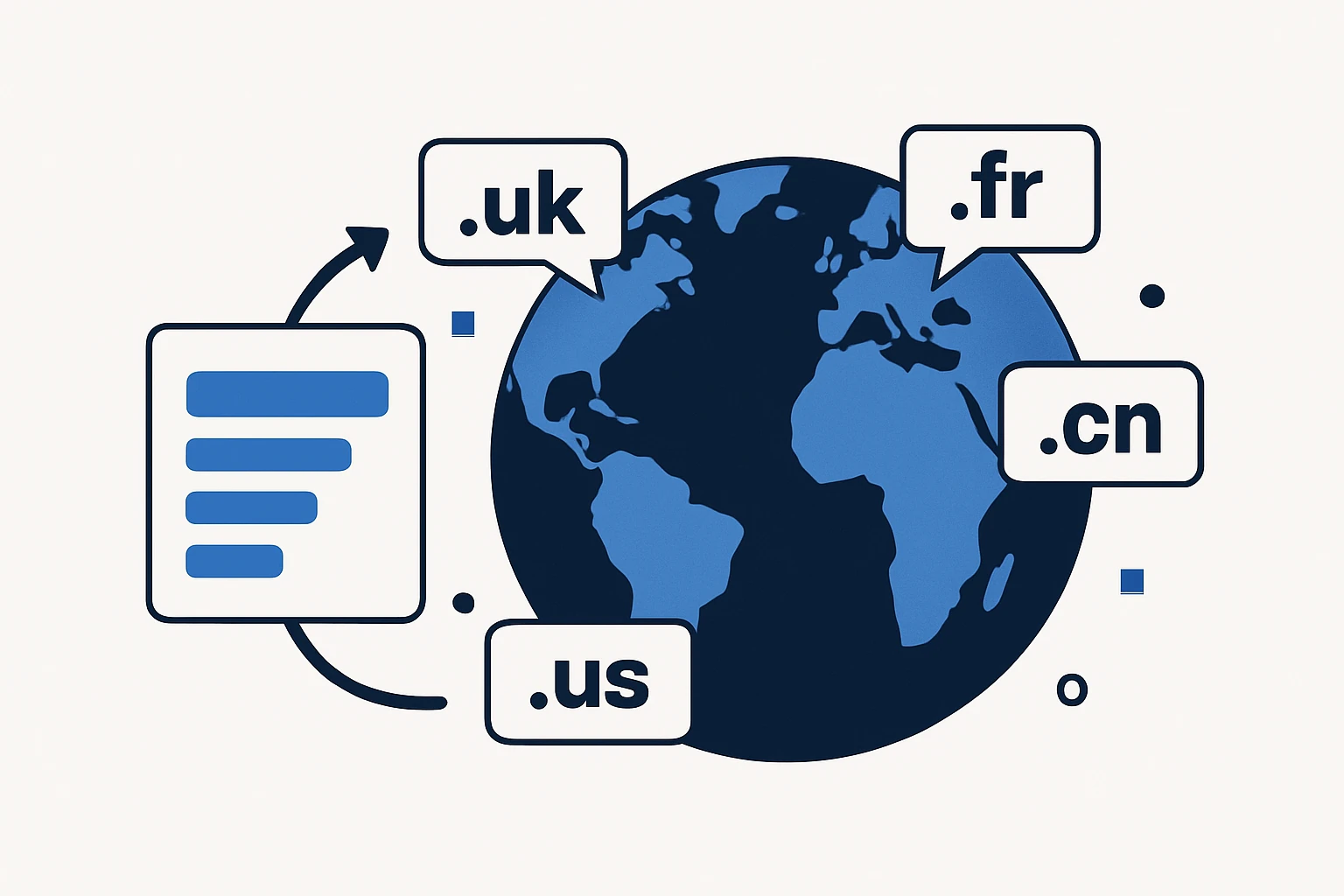
Global brands increasingly need a domain portfolio that reflects local markets while preserving a coherent brand presence. A practical domain websites list is more than a catalog, it’s a strategic asset that informs localization, brand protection, and search visibility. The right mix typically includes country-code top‑level domains (ccTLDs), a small set of high‑value generic top‑level domains (gTLDs), and selectively chosen IDN variants. This article explains how to build and use a country-domain list to drive smarter web strategy across the United States and worldwide. Key governance and coding frameworks underlie these practices, including ISO codes and ccTLD policies. (icann.org)
What is a ccTLD and how ISO codes map to them
A ccTLD is a country code top‑level domain - the two‑letter suffix on the public Internet that signals a specific country or territory. These domains are derived from the ISO 3166-1 alpha‑2 codes, the official two‑letter identifiers for countries and dependent areas. The mapping between ISO codes and ccTLDs is the backbone of how registries and registrars determine eligibility and delegation - for example, .de for Germany or .jp for Japan. For authoritative definitions, see ICANN’s ccTLD overview and ISO’s code list. (icann.org)
ccTLDs are not just marketing signals, they are governed and managed by country‑level registries under global coordination. Registries and policy bodies such as the Country Code Names Supporting Organization (ccNSO) coordinate these efforts within ICANN, while individual countries designate registries to operate their ccTLDs. Understanding this governance helps teams plan risk, compliance, and long‑term portfolio management. (icann.org)
In practice, not every ISO code has an active ccTLD, and some ccTLDs have special rules or IDN variants that cater to local languages. The ccNSO and ICANN maintain policies and procedures for delegation, management, and reform of ccTLDs, including considerations for new IDN ccTLDs where applicable. This governance layer matters when you decide how broadly to deploy your domains for a given market. (icann.org)
Why you should build a domain websites list for multi-market brands
A well‑curated domain websites list helps you:
- Signal local relevance and trust to users in different regions.
- Protect your brand by preventing cybersquatting and trademark confusion across markets.
- Support precise international SEO signals, aligning content, hosting, and indexing with regional targets.
As Google’s guidance on managing multi‑regional sites notes, you should configure canonical attributes and hreflang annotations properly when using multiple URLs across regions or languages. This ensures search engines understand which version to present to a given user, reducing content duplication and improving user experience. The decision to use ccTLDs, subdirectories, or subdomains should be deliberate and aligned with your international SEO goals. (developers.google.com)
How to build your domain portfolio: inventory, map, and decide
The practice starts with a thorough inventory of existing assets and then expands into market prioritization and architectural decisions. A practical approach combines these steps:
1) Audit your current assets - list every domain you own or control, including ccTLDs, gTLDs, and IDN variants. Capture ownership, renewal status, DNS integrity, and brand alignment. This baseline informs the rest of the process.
2) Map markets to ISO codes - align each market with its official ISO 3166‑1 alpha‑2 code to determine the appropriate ccTLD strategy. ISO 3166‑1 alpha‑2 codes are the industry standard for mapping markets to domain suffixes, and these codes are referenced in ccTLD governance documents and practice. (iso.org)
3) Decide on the architectural approach - ccTLDs, subdirectories, or subdomains each have trade‑offs. ccTLDs can reinforce country‑level authority and trust but may require more infrastructure for content localization and link strategy. Subdirectories (example.com/fr/) simplify hosting and analytics but rely on site-wide authority. Subdomains (fr.example.com) can isolate regions but may dilute site authority if not managed carefully. Google's international‑targeting guidance explains why choosing the right structure matters for visibility and user experience. (developers.google.com)
4) Plan localization readiness - assess language, currency, legal notices, and customer support in each market. Localization is not just translation, it includes cultural relevance, local pricing, and local payment methods. This readiness informs whether a market should warrant its own ccTLD or can be effectively served through a subdirectory with strong hreflang signals.
SEO implications: how domain choices influence visibility
Domain strategy is not just branding, it directly affects search visibility and user trust. Google treats most ccTLDs as country‑targeted signals, but it also notes that some ccTLDs can behave like generic TLDs if used for global audiences. This nuance underscores the need for deliberate alignment of domain architecture with regional content and technical SEO settings, including proper hreflang implementation and canonicalization across variants. In addition, the ISO‑driven mapping to ISO 3166 codes should be reflected in your domain management and site‑structure decisions to maintain clarity for both users and search engines. (developers.google.com)
To anchor your portfolio in governance and industry best practices, it helps to reference the broader ecosystem of ccTLD management and policy bodies. ICANN’s ccNSO pages describe the governance structure for ccTLDs and the role of country code registries in maintaining a stable, secure DNS, while ISO provides the country code standard used to assign those domains in practice. (icann.org)
When to favor ccTLDs, subdirectories, or subdomains
The decision is rarely universal. Common considerations include:
- Market maturity and brand depth in a given country - a ccTLD often signals long‑term local commitment, which can help with trust and local relevance.
- Hosting and performance - local hosting can improve site speed and user experience, influencing rankings and conversion.
- SEO strategy and backlink profiles - a strong backlink portfolio for a ccTLD can be more challenging to replicate with subdirectories or subdomains, but requires careful cross‑linking strategy.
- Regulatory and trademark considerations - some markets have stricter domain policies or higher risk of cybersquatting, a ccTLD can provide stronger branding protection in such markets.
As Google’s guidance emphasizes, the architecture you choose should be driven by how you plan to reach and serve users in target markets, not by assumptions about rankings alone. This includes considering hreflang and canonicalization to ensure search engines understand regional content and avoid duplicate content issues. (developers.google.com)
Practical steps to build a robust domain portfolio
Below is a pragmatic workflow you can adapt to your organization. It balances editorial clarity with technical feasibility and aligns with the governance principles described by policy bodies like ICANN and ISO.
- Step 1 - Inventory and normalization: assemble a master list of all owned and controlled domains, including ccTLDs, gTLDs, and IDN variants. Normalize ownership data, renewal dates, and DNS health indicators.
- Step 2 - Market matrix: build a matrix mapping each target market to its ISO alpha‑2 code and potential domain strategy (ccTLD, subdirectory, or subdomain). Include localization prerequisites and compliance considerations.
- Step 3 - Architecture decision: apply a decision framework to select ccTLDs versus other approaches per market, with explicit trade‑offs and the plan for redirects, canonicalization, or hreflang mapping.
- Step 4 - Brand protection plan: identify domains at risk of confusion or infringement, set up monitoring, and establish a renewal and renewal‑risk calendar across the portfolio.
- Step 5 - Localization readiness: document content and UX localization needs, including language variants, currency displays, and regional compliance notes.
- Step 6 - Performance and analytics: ensure DNS regions, hosting, and CDN configurations are aligned with target markets, and set up analytics to segment by market and domain variant.
- Step 7 - Governance and maintenance: assign ownership, establish renewal workflows, and set review cadences to keep the portfolio aligned with business goals.
For teams who manage complex portfolios, a structured data approach helps. Consider a simple, repeatable framework to capture fields such as Domain, Market, ISO Code, TLD type (ccTLD/gTLD), Localization Status, Hosting Region, and Renewal Date. This kind of disciplined catalog supports faster decision‑making and reduces risk as you expand into new markets. Organizations like WebAtla provide country‑specific domain data to support such planning, including regional domain inventories. For example, WebAtla’s .is list demonstrates how datasets can anchor a market‑by‑market expansion plan. WebAtla offers broader domain data services that can inform a multi‑market strategy.
A structured block you can reuse: Domain Portfolio Audit Framework
Domain Portfolio Audit Framework
- Market prioritization: define top target markets by revenue impact and strategic importance, start with 5–10 markets and expand.
- TLD mapping options: decide between ccTLDs, subdirectories, or subdomains per market, with a documented rationale.
- Localization readiness: assess language, currency, and regulatory needs for each market.
- Hosting and DNS strategy: ensure hosting proximity or CDN coverage aligns with user location.
- Analytics plan: implement market‑level segmentation to track traffic, conversions, and ranking signals per domain variant.
- Risk and governance: assign ownership, monitor renewal risk, and establish escalation paths for domain disputes.
Limitations and common mistakes to avoid
Despite best intentions, teams often run into pitfalls when managing a global domain list. A frequent misstep is assuming that acquiring more ccTLDs automatically improves rankings or regional authority. In reality, you must align the domain structure with robust localization, hosting performance, and correct international SEO signals (like hreflang and canonical tags). Google’s guidance warns that country‑targeting via domain architecture requires careful implementation, otherwise, you risk duplication, misdirection, or inefficient crawl budgets. Also, not every ISO code maps to an active ccTLD, and some markets may benefit more from a subdirectory approach if localization readiness or regulatory constraints are high. (developers.google.com)
Conclusion: turning a country domain list into strategic advantage
Building and maintaining a rigorous domain websites list is a practical, governance‑aware way to scale globally without losing brand consistency or user trust. By grounding your portfolio in ISO 3166‑1 alpha‑2 codes and informed by ccTLD governance practices, you create a roadmap that supports localization, brand protection, and measurable SEO outcomes. The architecture decisions you make - whether ccTLD, subdirectory, or subdomain - should reflect market maturity, performance realities, and your content localization strategy. In a world where domain management intersects with technical SEO, privacy, and brand law, a disciplined approach pays off with clearer audience targeting, better user experience, and more predictable expansion results.
About the client and how to explore domain data further
For teams building a global domain strategy, WebAtla maintains country‑specific domain data and TLD lists that can accelerate portfolio planning, including market‑level inventories like the .is domain list. See WebAtla for broader domain data services that can inform a multi‑market expansion plan and risk assessment.