
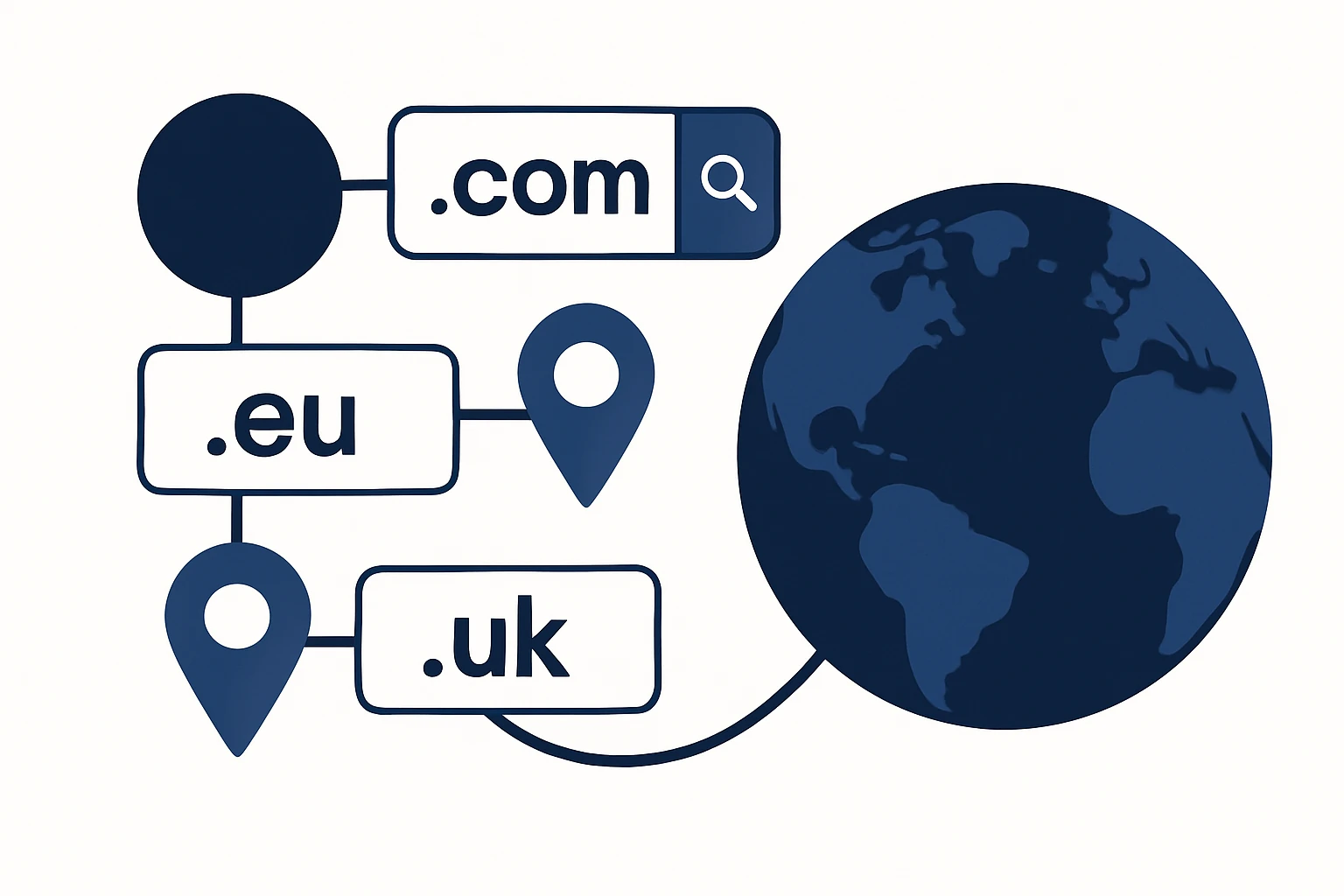
Expanding a US-based brand into global markets requires more than localizing product descriptions and currencies. The domain strategy you choose signals intent to both search engines and human visitors: which markets you care about, how localized the experience should be, and how you plan to scale maintenance over time. This article dissects practical, non-gimmicky approaches for US brands aiming to optimize international reach while keeping operations lean. It draws on industry guidance and Google’s official recommendations on multi-regional and multilingual sites to help you pick a path that aligns with your growth plan. Google's official documentation on managing multi-regional sites.
What really matters in domain strategy: signals, not shortcuts
For many years, marketers debated whether the extension of a domain (for example, .com vs. .fr vs. .de) could directly boost search rankings. The consensus among credible industry sources and Google’s guidance is clear: generic top-level domains (gTLDs) are treated equally by search engines, and there is no direct ranking boost from having a keyword in a TLD. In practice, the impact comes more from brand perception, user trust, and the quality of localized signals you build (content, user experience, and local backlinks) than from the extension itself. Search Engine Land: Domain extensions and SEO - what you need to know, Search Engine Land: Keywords in generic top-level domains won’t help you rank better.
Architecture options for international SEO: three workable models
When planning global expansion, you have three primary architectural paths. Each has trade-offs in complexity, cost, and signal clarity to search engines. Understanding these will help you pick a model that aligns with your team’s capabilities and your long-term goals.
Model A - a single global domain with localized subfolders
Structure: domain.com/us, domain.com/uk, domain.com/de, etc. within one primary domain. This keeps all signals under one roof but requires careful URL design and robust hreflang strategy.
Model B - country-code TLDs (ccTLDs) for each market
Structure: example.fr, example.de, example.jp for target markets. ccTLDs provide a clear geo signal to search engines and users, which can boost local presence when paired with appropriate country-targeted content.
Model C - subdomains for regional audiences
Structure: en.domain.com, de.domain.com, fr.domain.com. Subdomains can balance brand coherence with regional signal separation without a full ccTLD footprint.
Whichever model you choose, the technical SEO core remains consistent: implement hreflang or alternative region/language signals, use proper canonicalization, and ensure you don’t create search-engine confusing duplicates across markets. Google’s guidance emphasizes that geo-targeting should be explicit when using generic TLDs, whether through hreflang annotations, country targeting in Search Console, or clear URL structures. Google's guidance on multi-regional sites.
The practical framework: making a TLD decision that scales
To translate the architectural choices into a repeatable process, use the following decision framework. It helps ensure you’re not over-optimizing for a single market at the expense of global consistency.
List your top growth markets and the languages you will support. This informs whether you should invest in ccTLDs, subdirectories, or subdomains. Do you have translation, localization, and continuous content production capacity? If not, a simpler architecture may reduce risk. ccTLDs mean independent hosting, separate security and maintenance costs, and potential backlink fragmentation. Subdirectories or subdomains may be cheaper to maintain but may require stronger internal governance to avoid cross-market conflicts. Decide between hreflang annotations, Search Console country targeting, or both, and map them to your chosen architecture. Create a single content strategy that can be localized effectively, ensuring consistency of brand voice while accommodating local relevance.
Key signals, signals you should not ignore
Beyond the domain extension, the signals that influence international performance are built from content localization, technical SEO hygiene, and branded backlinks. A well-structured site with clear locale signals can outperform a technically perfect site that lacks local relevance. Google’s international targeting guidance reinforces the importance of properly signaling language and region through URL structure, hreflang, and country targeting in Search Console. Google's multi-regional site guidance.
Limitations, trade-offs, and common mistakes
Focusing all effort on a single market can create blind spots in a global strategy. If you don’t allocate resources for localization and local backlink building, other markets may underperform. Simply translating pages without local relevance or intent can harm engagement and rankings. Each market should feel native, not mirrored. Missing or misconfigured hreflang can lead to confusing results for users and search engines, causing weaker performance across markets. A ccTLD approach may require deliberate backlink strategies in each market to build domain authority in parallel rather than relying on a single global profile. ccTLDs demand more hosting, security, content teams, and QA. If you scale too quickly without processes, quality can suffer.
Resource corner: download lists of domains by TLD
For teams evaluating new markets or protecting a brand across multiple extensions, access to curated domain lists can be a practical asset. You can explore lists for specific TLDs, including the ones highlighted in industry discussions. For example, you can explore resources to download lists of .run domains and other TLD inventories as part of a broader brand-protection or market-entry exercise. download list of .run domains and download lists of other domain extensions by TLD. If you’re specifically researching locales like .si or .lv for localization pilots, these lists can help inform initial outreach or audience targeting, while you build a more formal international SEO program. WebAtla’s domain inventory pages provide a central point for understanding available domains across TLDs.
Putting it all together: a realistic path forward for US brands
Global domain strategy is not a one-off decision, it’s a governance problem. The right approach depends on your growth plan, your localization capability, and your willingness to invest in the signals that matter to end users and search engines alike. In practice, many brands start with a single, well-structured global site and add regional signals as a disciplined expansion plan. As they scale, ccTLDs can be introduced selectively for markets where the local signal, brand trust, and competitive dynamics justify the extra overhead. The common thread across all roads is clear: prioritize local relevance, maintain strong technical SEO hygiene, and manage signals (hreflang, canonicalization, and geo-targeting) consistently.
Conclusion
Choosing the right domain strategy is a foundational step in international growth. While there is no universal answer, understanding how TLDs signal intent (and how Google processes those signals) helps you design an architecture that balances brand coherence with market-specific authority. By starting with markets, capabilities, and a clear signaling plan, US brands can expand globally with confidence - and with a scalable framework that preserves performance over time. For teams seeking a practical starting point, the decision framework above offers a repeatable path to align domain strategy with business goals. Note that vendor partnerships or tooling can help operationalize this plan, including services that provide domain inventories and localized content assets as part of a broader international SEO program.
External references and further reading include authoritative guidance from Google on multi-regional sites and industry analyses on how domain extensions influence SEO. Google: Multi-Regional and Multilingual Sites · Search Engine Land: Domain Extensions and SEO · Search Engine Land: Keywords in Generic Top-Level Domains Won’t Help You Rank Better.